Red Clover
- Jul 29, 2025
- 2 min read
Updated: Oct 29, 2025
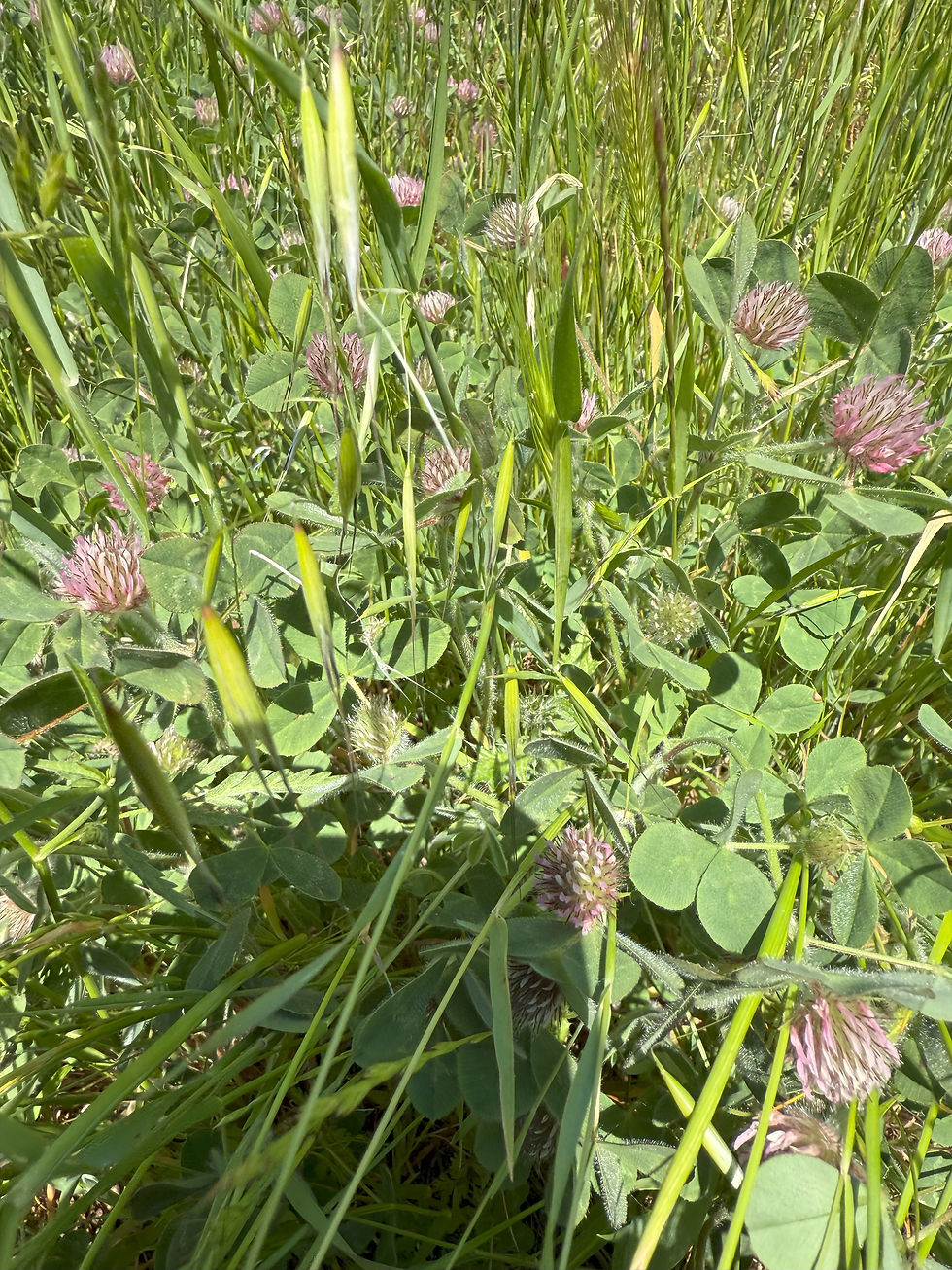
Red clover is a widespread and common species in meadows, pastures, and open fields throughout North America, Europe, and Asia. A low and spreading perennial plant, red clover is characterized by round pink-purple flower heads, and three-part leaves with distinctive faint white crescents across each leaflet. It is a nitrogen-fixing plant, which means it improves soil fertility for itself and its neighbors [1].
Red clover blossoms are edible, and mildly sweet. We like to add them to salads, dry them for tea, and blend them into pestos and herbal vinegars. Gatherers often pair them with leafy greens like chickweed or dandelion, but the blossoms are also lovely on their own. Like many wild flowers, they have a mild flavor, but a more pronounced profile of gentle nutrients including trace minerals, as well as isoflavones and plant-based estrogens [2][3].
In the herbal world, red clover has been used as a nourishing tonic, used to support hormonal balance, clear the skin, and invigorate the lymphatic system. In more recent times, scientists have studied its isoflavone content and its possible impacts on symptoms of menopause, bone density, and cholesterol [3][4][5]. While a gentle herb, red clover does have physiological activity and is a plant worth exploring.
Ecologically, red clover is a soil builder and bee food, and can help with the restoration of disturbed soils. From a wild or cultivated perspective, it straddles the worlds of food, medicine, and land regeneration. A simple, but generous herb that just keeps on giving.
[1] Žiarovská, Ján, et al. “Genes Associated with Biological Nitrogen Fixation Efficiency in Root Nodules of Trifolium pratense L.” Life 12, no. 12 (2022): 1975. https://doi.org/10.3390/life12121975.
[2] WebMD. “Red Clover – Uses, Side Effects, and More.” Updated 2024. https://www.webmd.com/vitamins/ai/ingredientmono-308/red-clover
[3] National Center for Complementary and Integrative Health (NCCIH). “Red Clover: Usefulness and Safety.” U.S. Department of Health and Human Services, updated 2024. https://www.nccih.nih.gov/health/red-clover
[4] Kanadys, Wioletta, et al. “Evaluation of Clinical Meaningfulness of Red Clover (Trifolium pratense L.) Extract to Relieve Hot Flushes and Menopausal Symptoms in Peri- and Post-Menopausal Women: A Systematic Review and Meta-Analysis of Randomized Controlled Trials.” Nutrients 13, no. 4 (2021): 1258. https://doi.org/10.3390/nu13041258
[5] Clifton-Bligh, P. B., et al. “Red Clover Isoflavones Enriched with Formononetin Lower Serum LDL Cholesterol — A Randomized, Double-Blind, Placebo-Controlled Study.” European Journal of Clinical Nutrition 69 (2015): 134–142. https://doi.org/10.1038/ejcn.2014.207.


