False Turkey Tail
- Apr 24, 2025
- 1 min read
Updated: Oct 29, 2025

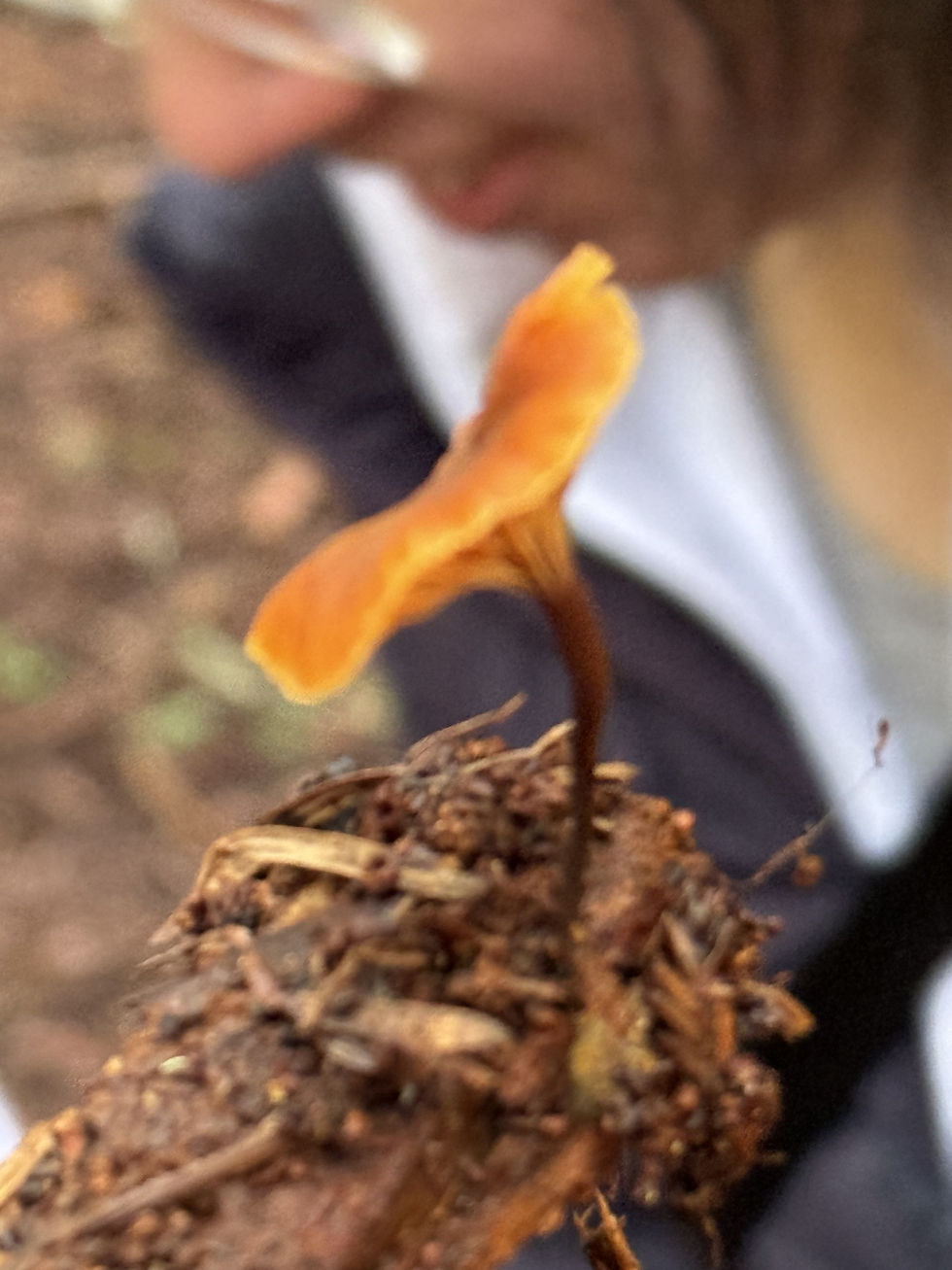
Stereum hirsutum is a widely distributed wood decay fungus, which grows on fallen branches, stumps and logs of hardwood trees in temperate regions. It produces thin leathery fruiting bodies that cover the surface of the wood in irregular patches that often overlap and meet each other. Its upper surface is orange-yellow to brown in colour, and often banded and finely hairy, while the underside is pale and smooth, with the pores that are a characteristic of the "true" turkey tail, Trametes versicolor, absent [1][2].
As a saprotroph S. hirsutum is especially good at breaking down lignin and cellulose, two of the most recalcitrant organic substances found in wood. In doing so it converts complex plant debris into available nutrients, enhances soil structure and fertility and efficiently recycles nutrients in forest ecosystems by colonizing large areas of dead wood [3][4].
In comparison to its larger bracket fungus cousins, Stereum hirsutum may seem unremarkable, but, like all fungi, it performs an important ecological role. Breaking down and recycling plant debris, its activities are an essential part of natural cycles of decomposition and renewal.
[1] MushroomExpert.com. “Stereum hirsutum — MushroomExpert.com.” https://mushroomexpert.com/stereum_hirsutum.html
[2] First Nature. “Stereum hirsutum – Hairy Curtain Crust.” https://first-nature.com/fungi/stereum-hirsutum.php
[3] Mirić, Milenko. “Decay of Oak Wood Provoked by Fungus Stereum hirsutum (Willd. ex Fr.) S.F. Gray and Its Essential Physiological Requirements.” Glasnik Šumarskog Fakulteta: Univerzitet u Beogradu 91 (2005): 179–192. https://doiserbia.nb.rs/img/doi/0353-4537/2005/0353-45370591179M.pdf
[4] PlantIary. “Hairy Curtain Crust (Stereum hirsutum) Mushroom Identification, Habitat & Ecological Role.” https://plantiary.com/mushroom/stereum-hirsutum_1810.html