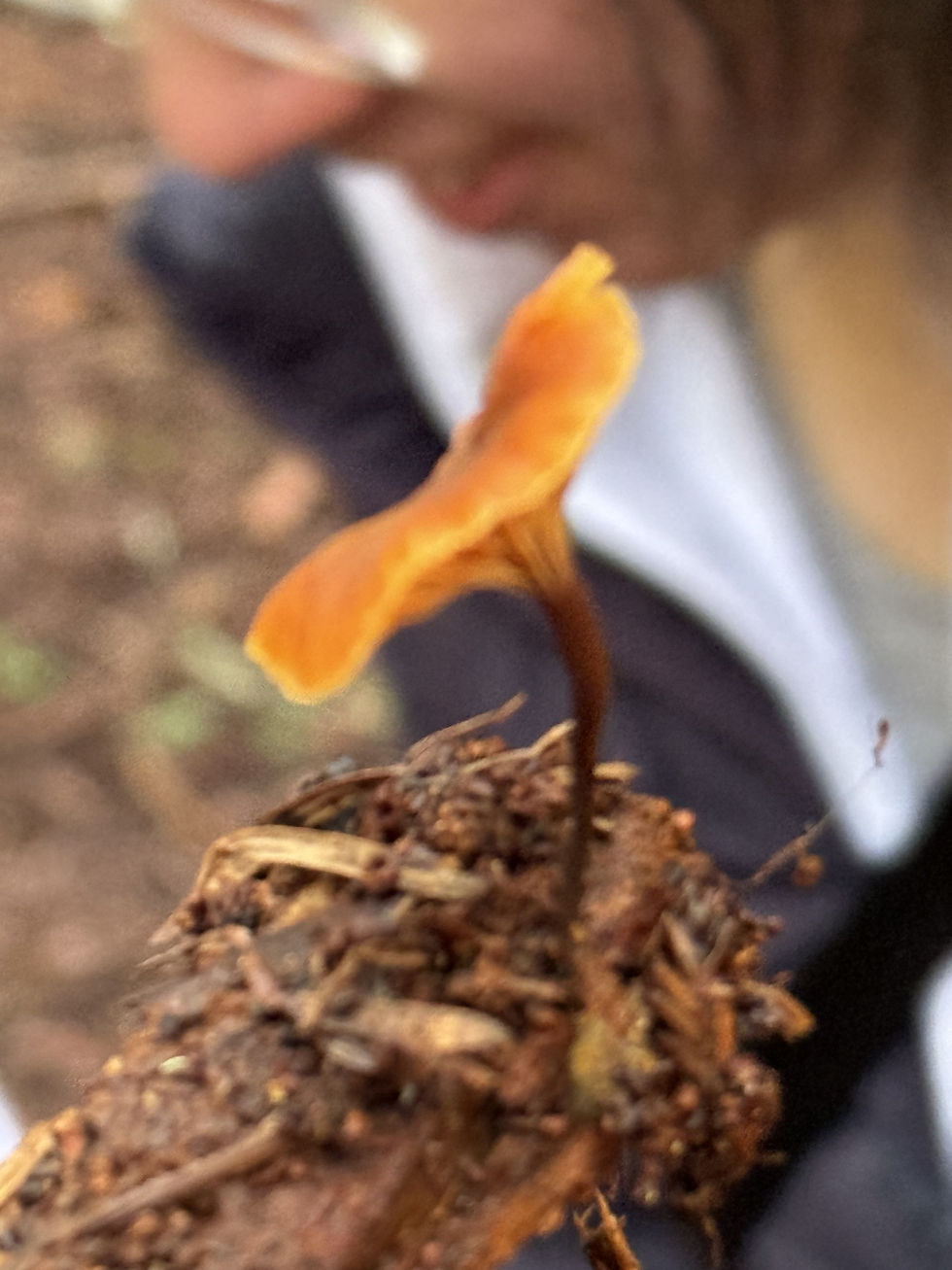
Fringecap brittlestem
- Apr 15, 2025
- 1 min read
Updated: Oct 29, 2025

Psathyrella longipes is a fragile, saprotrophic species found growing on wood or rich, woody leaf litter in moist forests or wooded glades. It can be recognized by its hygrophanous cap which changes from a dark brown when moist to a pale tan color as it dries. This species has a long and slender stipe that can often be longer than its small cap. This characteristic, and the fact that the stipe often extends above the decaying debris in the understory, is what the species is named for [1][2].
Ecologically, P. longipes acts as a decomposer. It is involved in nutrient cycling and the slow breakdown of cellulose and lignin in plant debris. By decomposing dead plant matter, it recycles the nutrients into a more readily available form, making them available to soil organisms and seedlings. In this way, P. longipes promotes the regeneration of understory plants, as well as the long-term fertility of forest soils [2][3].
P. longipes has also been found to be sensitive to conditions on the forest floor, including moisture, organic matter, and light. In this respect it is sometimes used as an indicator of active cycling on the forest floor [2]. The brief appearance of the fruiting body is a reflection of the rate and vigor of decomposition in the woodland [3].
[1] Mushroom Expert – Psathyrella longipes: morphology and identification details.https://www.mushroomexpert.com/psathyrella_longipes.html
[2] MycoWeb – Psathyrella longipes in California Fungi: habitat and ecological notes.https://www.mykoweb.com/CAF/species/Psathyrella_longipes.html
[3] Wikipedia – Psathyrella longipes: distribution, taxonomy, and ecological information.