Bitter Oyster
- schen3154
- Apr 4, 2025
- 2 min read
Updated: Oct 29, 2025

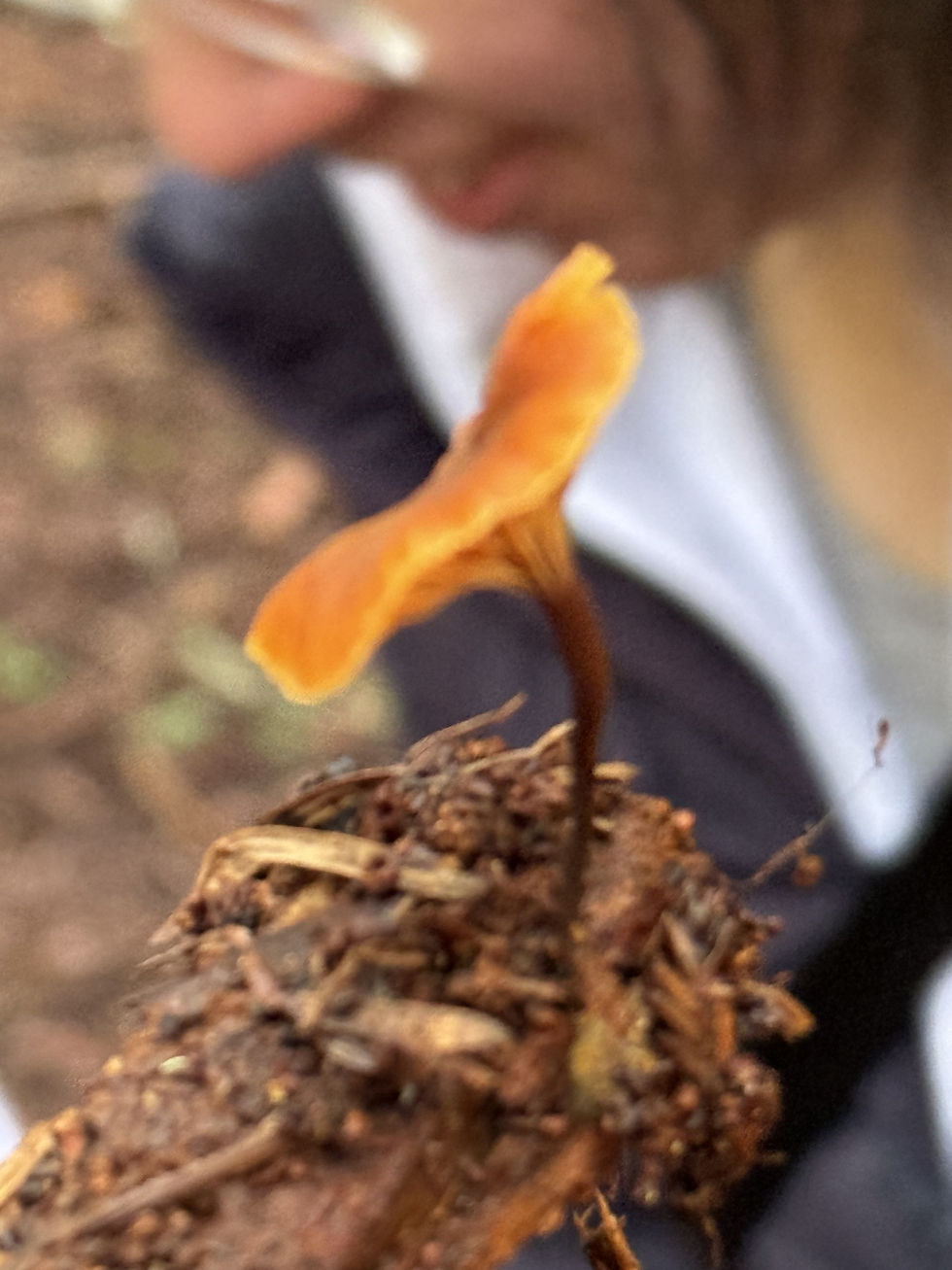
Panellus stipticus is a small saprobic wood-decay fungus that grows gregariously in overlapping groups on the stumps or fallen hardwood logs in temperate forests. It has fan-shaped to semicircular, pale ochre to tawny brown caps that are often velvety and irregularly concentrically zoned. The gills are decurrent on a short lateral stem. It is a widely distributed species with a circumboreal distribution. In some regions its fruiting bodies are weakly bioluminescent, which is attributed to the presence of luciferase enzyme that catalyses the oxidation of luciferin and generates light energy from chemical energy [1][2].
P. stipticus is considered to be an effective saprotroph (that gains nutrients from decomposing materials) of lignin and cellulose of fallen wood. The decomposition activities of this fungus and other wood-decay fungi releases a significant amount of nutrients into forest soils which not only aids in supporting a rich diversity of microhabitats and microflora but also in recycling nutrients. It has been observed that white rot group of fungi (Panellus is a member of this group) use oxidative enzymes, mainly laccases and peroxidases to break down lignin, which is one of the most abundant organic polymers on Earth, and in this process play a very significant role in cycling of carbon through forest ecosystems [3][4]. It has also been recorded on wood that has fallen recently as well as wood that has been decayed for a long time [2][5].
P. stipticus is therefore seen to be an important fungus in supporting the productivity of forest ecosystems. Owing to its broad distribution and ecological characteristics, it is also considered to be an indicator of a healthy and in-balance forest ecosystem where the rates of decomposition, regeneration, and biodiversity are well balanced with one another. The weak bioluminescence of this fungus is one of the rare forms of bioluminescence observed in forest ecosystems, providing a spectral glimpse of a hidden world that lies beyond the reach of human senses [6].
[1] Kuo, Michael. “Panellus stipticus.” MushroomExpert.com. Accessed October 2025. https://www.mushroomexpert.com/panellus_stipticus.html
[2] Wikipedia contributors. “Panellus stipticus.” Wikipedia: The Free Encyclopedia. Last modified 2024. Accessed October 2025. https://en.wikipedia.org/wiki/Panellus_stipticus
[3] Janusz, Grażyna, Agnieszka Pawlik, Anna Świderska-Burek, et al. “Lignin Degradation: Microorganisms, Enzymes Involved, Genomes Analysis and Evolution.” FEMS Microbiology Reviews 41, no. 6 (2017): 941–962. https://doi.org/10.1093/femsre/fux002
[4] Cui, Zhen, Xiaoqian Li, and Chengrong Chen. “Lignin Biodegradation and Its Valorization.” Fermentation 8, no. 8 (2022): 366. https://www.mdpi.com/2311-5637/8/8/366.
[5] Plantiary. “Panellus stipticus – Identification, Habitat & Uses.” Plantiary Species Database. Accessed October 2025. https://plantiary.com/mushroom/panellus-stipticus_2241.html
[6] Mushroom Mountain. “Glowing Panellus – (Panellus stipticus).” Meet the Mushrooms. Accessed October 2025. https://mushroommountain.com/glowing-panellus-stipticus/