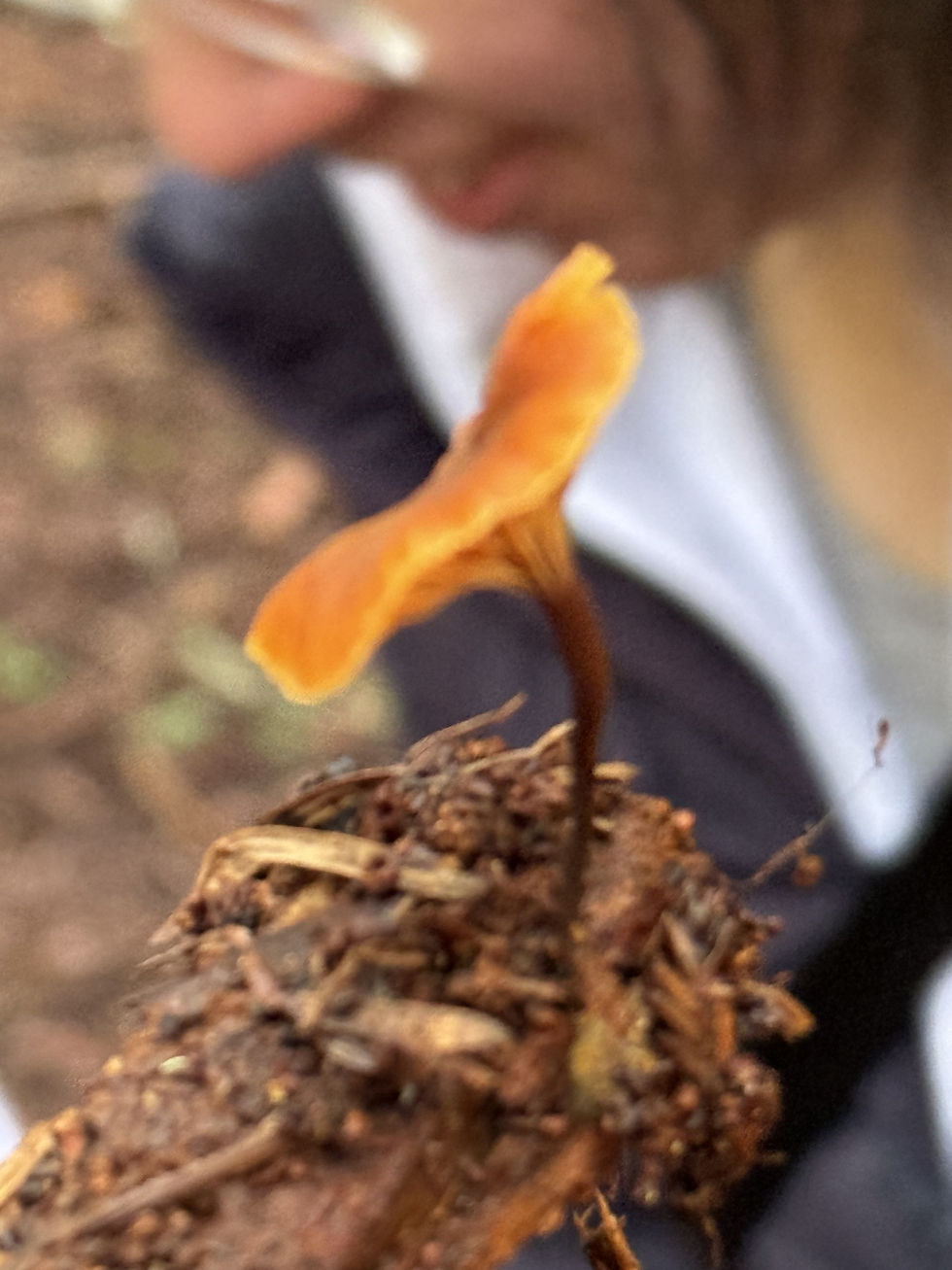
Cabbage Parachute
- Apr 20, 2025
- 1 min read
Updated: Oct 29, 2025

Gymnopus brassicolens is a small saprotrophic species with a translucent-striated cap and strong fetid odor. The caps are honey to amber-brown and often moist-shining, the gills buff to whitish and adnexed. The stipe is slender, pallid toward the apex and often darkening toward the base. Fruitbodies are scattered to gregarious on leaf litter and woody debris under hardwoods and conifers [1][2].
Gymnopus brassicolens grows in decomposing litter and fine woody debris and is thus involved in the decomposition of complex plant polymers and the recycling of nutrients back into forest soils. It is a leaf-litter saprobe in the Gymnopus/Marasmioid group which, as its name implies, contributes directly to the carbon turnover and soil renewal of litter typical of marasmioid fungi [3][4].
A small and easily overlooked species, G. brassicolens nonetheless plays a small but important part in forest nutrient cycling – the conversion of litter into accessible nutrients, and in maintaining the background processes that underpin ecosystem resilience [4].
[1] MykoWeb. “California Fungi: Gymnopus brassicolens.” https://www.mykoweb.com/CAF/species/Gymnopus_brassicolens.html
[2] Plantiary. “Cabbage Parachute (Gymnopus brassicolens).” https://plantiary.com/mushroom/gymnopus-brassicolens_596.html
[3] Romagnesi, H. 1952. “Sur deux nouveaux marasmes fétides et leur position taxonomique.” Bulletin trimestriel de la Société mycologique de France 68: 139. Available via Gallica (BnF): https://gallica.bnf.fr/ark:/12148/bpt6k3210068x
[4] Antonín, Vladimír, and Machiel E. Noordeloos. A Monograph of Marasmius, Collybia and Related Genera in Europe. Part 2: Collybia, Gymnopus, Rhodocollybia, Crinipellis, Chaetocalathus, and Additions to Marasmiellus. Eching: IHW-Verlag, 1997. Open copy: https://archive.org/details/monographofmaras0017anto