Artist conk
- Apr 18, 2025
- 1 min read
Updated: Oct 29, 2025

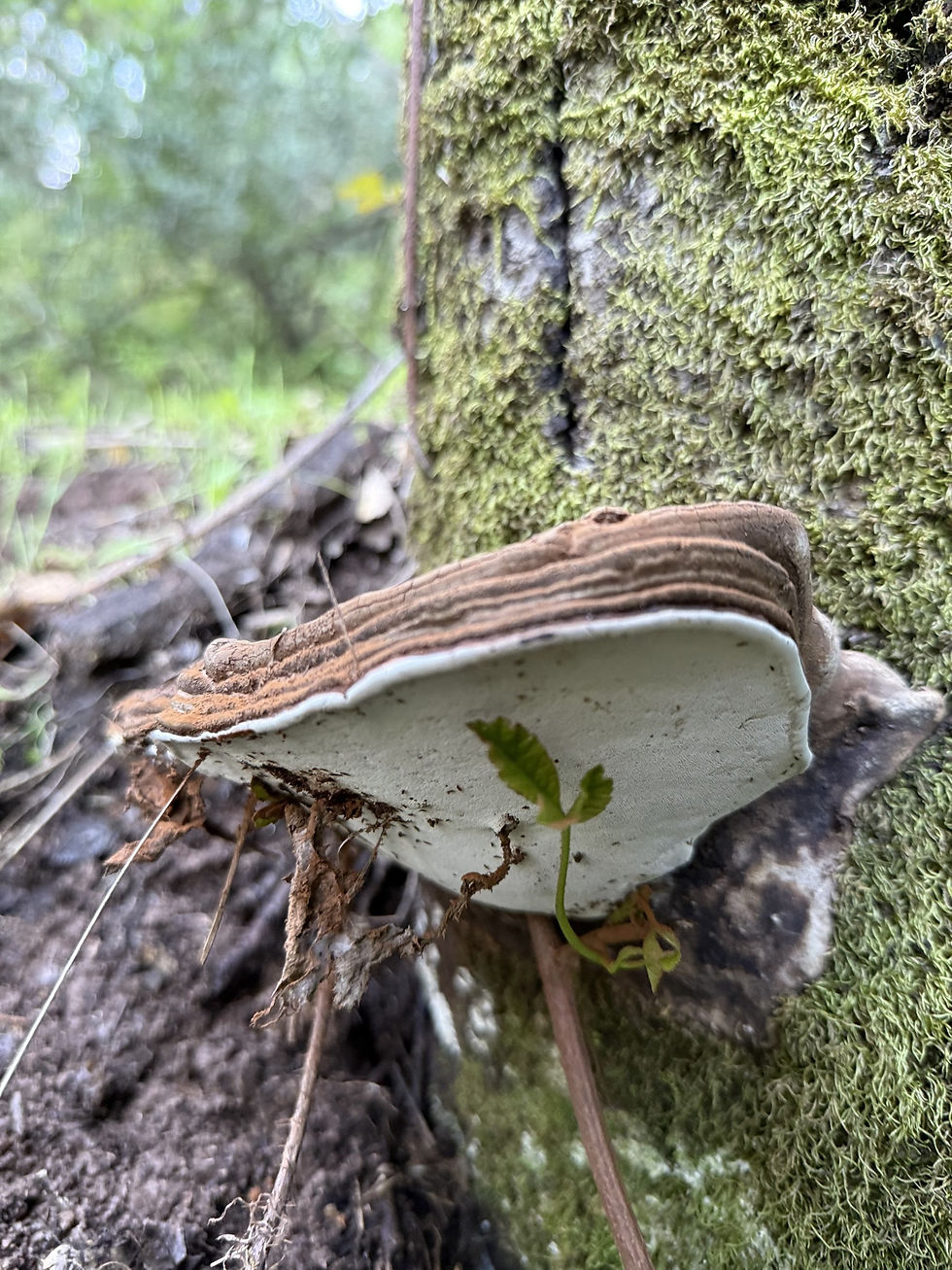
Ganoderma applanatum is a tough perennial bracket fungus on older or dead hardwoods. The fruiting body consists of a broad, shelf-like conk that continues to grow for several years. The upper surface slowly turns darker as new layers form below it [1][4].
The pore surface on the underside of the conk is pure white, and stains brown when touched or scraped; this hypersensitivity to touch is what is behind the common name, as the fungus can be used as a drawing canvas [2][4].
Ecologically, Ganoderma applanatum acts as a parasite and saprobe on living trees, often entering through a wound. It causes white-rot of the heartwood, and can continue to decay dead wood, breaking it down and making the nutrients available to other organisms [3][4].
The fruiting body, which can live for many years, can be thought of as a natural time capsule. Layer after layer of growth, spores, and environmental interaction accumulate, turning the conk into a biological chronicle of decay [2][5].
[1] UMass Amherst, Dept. of Plant, Soil & Insect Sciences. “Root and Trunk Rot caused by Ganoderma applanatum (Artist’s Conk).” https://www.umass.edu/agriculture-food-environment/landscape/fact-sheets/root-trunk-rot-caused-by-ganoderma-applanatum-artists-conk
[2] Volk, Tom. “Ganoderma applanatum, the artist’s conk.” https://botit.botany.wisc.edu/toms_fungi/march99.html
[3] Davey Tree Insect & Disease Resource Center. “Artist’s Conk | Ganoderma applanatum.” https://www.davey.com/insect-disease-resource-center/artist-s-conk/
[4] Kuo, Michael. “Ganoderma applanatum.” MushroomExpert.com. https://www.mushroomexpert.com/ganoderma_applanatum.html
[5] MykoWeb. “California Fungi: Ganoderma applanatum.” https://www.mykoweb.com/CAF/species/Ganoderma_applanatum.html